Friday, October 20, 2017

What can we say come December 31? Still Christmas

    December 31 is a quirky time to preach. I’ll expect a severe attendance drop-off… but then those quiet Sundays can be lovely. There is so much preaching fodder around the date – although I’d sure avoid urging people to make new year’s resolutions that would make your church, or even their lives run more smoothly. I think of course of Wesley’s Covenant Prayer, a great New Year’s compact to make with God (although I always suspect that it means more to me having studied it on a page than it can to people out there trying to listen to me read it).

     There is a fascinating week of Kwanzaa, whose traditions of long leisurely meals where you talk about tradition, ancestors, culture, and dreams, seems about as Christian a way to end one year and bring in the next as anything I could concoct.  And then I ponder the way New Year’s is a huge deal in largely African-American churches – all because of Lincoln’s Emancipation Proclamation. Freedom – not American-style freedom so much as that Gospel freedom Paul envisions in Galatians: that’ll preach.

     I think though I will devote my sermon to the Gospel text, Luke 2:22-40, and ruminate on Jesus’ very early life. For another project I’ve been reflecting on this – and so I share what I have with you:

***

     What was Jesus’ very early life like, his first few days and weeks? We love the carol which suggests “little Lord Jesus, no crying he makes.” Surely he cried. We should hope he cried. He became one with all of us who cry. Babies cry, and we may be grateful, as that sound is the sign of life, vitality, a protest against being so rudely removed from the warm safety of the womb, a declaration to the world that “I have arrived” – and “something’s wrong.” As an adult, Jesus wept over the city of Jerusalem, over the death of his friend Lazarus, and he surely still weeps over us. His name, after all, is a cry, yeshua meaning “Lord, help!” 

     Mary nursed him, rocked him, whispered and sang to him. Exhausted like all mothers, she fought through the weariness. Did she suffer any postpartum depression? There were visits. The shepherds flocked toward his manger, perplexed and overstimulated by what they swore they’d seen and heard out in the fields, angels trumpeting and singing. The magi appeared in course, right away or months later, we have no way of knowing – just as we don’t know how many of them made the trek from Persia or Arabia or wherever. We guess three, since they three gifts; but artists have depicted four, or seven, or a dozen.

     Mary and Joseph, of course, were Bible people, thoroughly Jewish, and their Jewishness shaped the small, beautiful and thus expansive world Jesus first glimpsed in his first days. And so Mary, on cue, did as all Jewish mothers did: she and her family made the arduous journey to Jerusalem for her “purification.” Catholic tradition and even Protestants’ best hunches make us shrug, wondering why she of all mothers would need to be purified. But having just borne God’s own son, she stuck to the law, seeking to be as pure and holy as possible in God’s eyes – perhaps akin to the way Jesus, God in the flesh, holiest of the holy, submitted to Baptism. And as pious, observant Jews, hardly done with the Torah now that Jesus has arrived, they offered up a couple of sacrificial birds on the altar.

     And then, being diligent in faith, Mary and Joseph delivered their son to the priest for circumcision, which for them was a non-negotiable act of obedience and devotion to God. I wonder if Mary felt her first pangs of separation when she handed her infant son over to a priest she’d never met, and if she shivered a bit when she heard his outcry when the knife cut into his flawless flesh. Another unexpected pain was about to hit her.

     Seemingly by chance, Mary and Joseph bump into an old man named Simeon. And then a woman named Anna who had been a widow for eighty four years.  The aged inevitably turn and gaze at an infant, as if the chances to glimpse such precious beauty are numbered. Or was he somehow, even if unwittingly, dispatched there by God? “It happened that there was a man.” Chance, maybe. But then verse 27 exposes what even he may not have known – that he was “led by the Spirit.” This “upright and devout” one was not alone in “waiting for the consolation of Israel” (Lk 2:25). But some mystical disclosure had come to this man – that he would not die before seeing the Messiah. Do mothers today encounter various older people who figure in profound and surprising ways into the unfolding drama of their children’s lives? Does God send such people into our orbit to shape the puzzled parents’ new world?

     Simeon took the child. Mary would forever be handing her child over to the hopes of others. His prayer over the child must have struck Mary and Joseph dumb. “Now let your servant depart in peace,” for this Messiah (even in infancy) had come, “a light for revelation to the Gentiles, and glory for Israel.” We deploy extravagant hyperbole when speaking of a newborn, but this is over the top, outrageous, either divinely inspired or sheer craziness. 

     Would that he had stopped with his blessing. In somber tones, Simeon spoke directly to Mary: “Behold, he is set for the fall and rise of many in Israel… A sword will pass through your own soul.” These densely framed words require considerable exegesis, and much pondering from Mary. His destiny involves the “fall and rise” of God’s people. The order should puzzle us. We speak of the “rise and fall” of, let’s say, the Roman Empire, a British dynasty, or a famous politician. With Jesus, as Scripture has tutored us to expect, turns everything upside down. Those drawn into the wake of this child will learn that you fall before you rise, you get emptied of your own goodness before you are filled with the mercy – and the same happens with God’s church, rising like a phoenix only after suffering the worst persecution.

     The pattern will be Jesus’ own. He will fall, flagellated by the soldiers, then beneath his own cross, and finally crushed by death itself, only then to rise, and to reign. This fall will indeed pierce Mary’s heart. Simeon was right: she would barely be able to stand at the foot of the cross, trying to avert her gaze but not being able to do so from the sight of the lifeblood she had given him draining out of his precious, pure body. Whose heart was more crushed than hers? Who felt the piercing of the nails and the spear more than his mother? Who, even after his resurrection and ascension, felt the pangs of missing him more than his holy mother?

     We may pause and consider prophecies, most of them surely unintended, that are uttered over our children. Sizing up mom and dad, the doctor says He’ll be a tall one! Or as a premie beats the odds and exhibits surprising growth, the nurse says She’s a fighter! Or the too-young mother in labor and delivery, with no family hovering nearby, the obstetrician shrugs and hangs her head: That one is already behind the eight ball. I have vague recollections of overhearing awful words in my own house growing up – that when my older sister was born, they had really wanted a boy. So I was their boy! and she was not – a terrible prophecy.

     Were there prophecies you’ve overheard about yourself? Some are cute, but loaded. We got Duke bibs and socks for our wee ones – so did they feel they failed to fulfill their promise when they didn’t go there? Some prophetic messages that impact our children are entirely unnoticed and unspoken. Like parental anxiety – over what to do with a little one, or over how terribly scary the world is out there.

     And then we have (in Matthew… which Jesus won’t mind me jumping to) the slaughter of the Innocents. The horror – as there is always horror in the world, and perhaps especially when we get close to the holy and good. Herod recoiled against this small, humble birth just 6 miles from his palace – maybe like that haunting moment in Peter Jackson’s film version of “The Lord of the Rings.” The wicked “eye of Sauron,” atop a high tower, casts its evil beam over the land, probing, ruling, intimidating, always watching for signs of good to be dealt with.

     Then that holy hobbit, Frodo, put on the ring of power – and the eye was seized with some paroxysm of envy and terror, jerking suddenly in Frodo’s direction, far away. Notorious for his paranoia, famously feeling threatened by and then killing members of his own family, Herod flew into what for him was a typical rage, ordering the cruel slaughter of all male boys under the age of two in his realm. The arrival of the Christ child was no security blanket to shelter the people from harm. On the contrary, his advent actually brought on intense sorrow, such is the ferocious kneejerk retaliation of evil in our broken world against the good that would bring life – back then, and throughout history. The laments, the shrieks of the mothers of Judea have echoed through time. If we listen, we can still hear them, and all mothers who have flailed and strained and crumpled to the ground in sheer agony as they have witnessed brutal violence against their children. A mother wrenched from her small son in Auschwitz, forced to watch with the rest of the horrified crowd as he was dangled by a rope around his neck. A man in the crowd asked, “For God’s sake, where is God?” Elie Wiesel, who was there, said he heard a voice answer, “Where is he? This is where – hanging here from this gallows.”
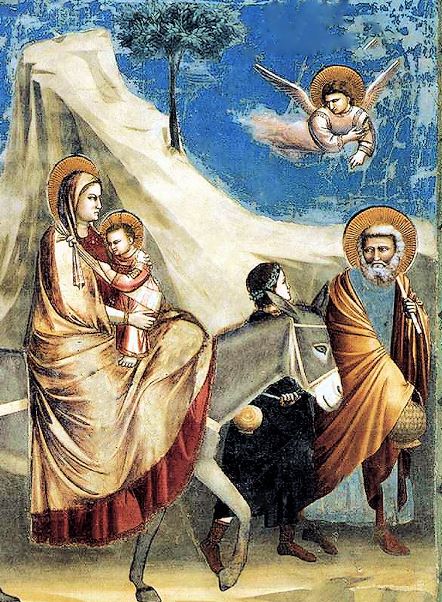
     Of course, thanks to a good angel who had warned Joseph, the infant Jesus has been spirited away to Egypt. By stealth the holy family fled by night. Legend has it that lions and leopards in the wilderness bowed their heads and wagged their tails in homage; palm trees bent low to provide food for them; two thieves pounced on them, but then relented when Mary wept – the same robbers who were crucified next to Jesus thirty years later. The symbolism of the story would not have been lost on Jews of Jesus day or careful Bible readers today. This one, who has come to be the deliverance of the people, descends to Egypt, as Joseph and his brothers had centuries earlier, only to return in peace to the land of promise.

     Still in his infancy, Jesus is a refugee, joining the ranks of countless throngs of people pushed out of their homelands, in desperate flight to survive grisly armies and rulers. I have known Jews who managed to slip out of Europe and elude the Nazis murderers; a neighbor of mine was hidden in a potato sack and thrown onto the back of a truck by her parents, whom she never saw again. Refugee camps dot the globe. Particularly haunting are those camps in the land of Israel to which Jesus came. In his birthplace of Bethlehem, camps like Dheisheh and Aida have been the home for thousands of Palestinians expelled from their homes, and living in coarse conditions, for generations now since the war in 1948.

     After that quick visit to Jerusalem for purification and circumcision, the Bible tells us nothing at all about Jesus’ childhood until he is twelve years old – beyond the scope of what we’re attempting in this book. But that moment is instructive. The holy family made their way to Jerusalem as part of a caravan of travelers from Nazareth to the high festival days in Jerusalem. Headed for home, somehow Jesus got misplaced, and his parents couldn’t locate him for three days. Once they did, Mary upbraided him: “Son, why have you treated us so? Behold, your father and I have been looking for you anxiously” (Luke 2:48). Indeed. Even they are learning what all religiously seriously parents learn: you do not know what God is calling your child to become.
 
     We imagine Jesus as some prodigy, outsmarting the smart, teaching the brilliant. But if you read the text closely, it's a dialogue, and Jesus is asking questions more than spouting theology. A commendable way to begin a year...
 
****
The images are paintings of the life of Christ by Giotto in the Scrovegni Chapel in Padua.
 

Wednesday, October 18, 2017

God Became Small: Preaching Advent

   {see also "Preaching Christmas," my next blog}

    Preaching is so very different during Advent.  For years, I felt like I had to battle the vapid Christmas culture out there, or I knocked heads with musicians infringing on my sermon time.  But I have come to embrace the challenges, which can become peculiar delights for the preacher.

     In most churches, Advent is a music-dominant season.  Instead of competing with the music, join forces.  I can think of no richer season to talk about the music; I wrote a whole book (Why This Jubilee?) on the theology and poignant phrases in our carols.  Don’t we want to guide our listeners into praying “Be near me, Lord Jesus, I ask thee to stay close by me forever, and love me I pray; bless all the dear children in thy tender care, and fit us for heaven to live with thee there.”  “Why lies he in such mean estate?”  Unpack that one and you’ve got a sermon.  Even “All the other reindeer used to laugh and call him names” has social justice implications.

     With cantatas, advent candle lighting, children’s montages and more, there is frankly less time for the sermon.  Do I say Dang! in frustration? Or is there a kind of relief?  I only have to fill seven minutes.  The shorter sermon requires more discipline and focused preparation 
– but remember that America’s greatest speech ever, Lincoln’s Gettysburg Address, was a mere 272 words.  At my place, December Sundays are more crowded, and there’s more racket – all the more reason to keep it brief and to the point.

     I suspect that fewer words are more fitting given the two predominant moods of the season.  There is of course, all the frivolity, the silliness, usually with some trite Christmasy sentiment pasted on: “Jesus is the reason for the season!”  “Keep Christ in Christmas!”  “It’s Jesus’ birthday party!”  A focused, crisp alternative to the froth – not scolding, but offering some richer fare – is more likely to be heard in 10 minutes than in a 25 minute monologue.  Think of the impact of Mike Slaughter's simple and direct Christmas is Not Your Birthday.  5 words, covers a lot of ground.

     And of course, the other, weightier mood?  The grief, the loneliness, the dysfunctional families, the infertility, the brokenness: the darkness people bear, hidden, is most acute when “Tis the season to be jolly.”  Grieving people cannot bear many words.  Comfort comes in few words, staying with the silence, listening, showing in the eyes and body language that you understand, you love, you share the sorrow.

     Some churches do a “Blue Christmas” service; we call ours “Hope and Consolation” – a time for those feeling intense grief to gather, light candles, cry and hug.  I think it’s important that not be a one-off.  Every Sunday in some way I name the ache, the darkness.  Christmas is just an inch after the longest night of the year, and there was much fear and then horrific grief that accompanied Jesus’ birth.  I send a piece I wrote about “Grief and Great Loss in the Season of Joy” to everyone who suffered the death of a loved one in the past year; use it yourself if you’d like, or create your own.  It’s important.

     In Advent preaching, it’s crucial to settle on what’s important and what isn’t.  Early in my ministry, I was a zealot for Advent – as in no Christmas carols, etc.  Not only was I banging my head against a wall and needlessly exasperating my people, I realized that my liturgical correctness after a while didn’t make sense even to me.  I try to pretend Jesus hasn’t come yet; but we’re doing this because he came.  Even the most Christmasy carols have an Advent longing: “O holy child of Bethlehem, descend to us, we pray.”  “Let every heart prepare him room.”  Sounds like Advent to me.  I can’t be sure, but I’m betting Jesus doesn’t mind us singing about his birth before the 25th.

     I’d also say dogma matters, and enormously – but it’s not a season for theological explication in preaching.  I need to have my theology of incarnation worked out – and the sermons I read and hear (from students and colleagues) tend to underattend to the robust wonder that the incarnation is.  It is not that Jesus got born as a necessary step toward teaching, healing, dying and rising.  Sam Wells, in his fabulous A Nazareth Manifesto (which is maybe the most important theology book in a decade), explains well what I’ve touched on for years: God’s saving comes primarily in the Incarnation.  What makes Christianity unique is that God entered into our fleshly life.  God is with us – Immanuel at his birth, and then in his parting words at the ascension – and this is the ultimate truth for us.  Otherwise we get into thinking of Jesus as fixer of our problems, and the churches constrict mission to fixing somebody else’s problems.  The Gospel is simpler, better, weirder, and finally more merciful: God in Jesus is with us.

     But Advent isn’t the time for long, complex sentences or dogmatically shrewd paragraphs.  We go short, we go small.  During December I keep Rembrandt’s “Adoration of the Shepherds” as my computer wallpaper to remind me: only a few words, in the dark, like a candle.  Martin Luther’s revolutionary thought was that God became small for us in Christ; he showed us his heart so our hearts might be won.  It's the God hidden in weakness - or the God who quite genuinely is tender vulnerability.
Or perhaps it was St. Francis who created history’s first manger scene at Greccio.  Before that, if Jesus were ever depicted as an infant or child, he looked like a powerful potentate simply painted littler.  Francis understood the tender vulnerability of Jesus.  He preached at that moment, and listeners said his voice sounded like the bleating of a lamb.  He ordered that all the animals, cattle, livestock, sheep, dogs, be given a double portion to celebrate Christ's birth.

     We get at this through stories.  Not corny, sappy stories, but those fraught with joy, fear, darkness, delight. 


Every year I re-read Walter Wangerin’s marvelous “The Manger is Empty” for myself – and have even read it to my people as a sermon.  The pastor's daughter suffers the death of a beloved friend just before Christmas - and then she has to play Mary in the pageant.
I keep going back to the novel I read in high school but couldn’t really comprehend until I had many more years on me:  Silas Marner.  Let me excerpt some of it: George Eliot told us of this reclusive miser, left utterly wretched and desolate once his stash of money was stolen.  But when he came home one evening, he found, “instead of hard coin,” some soft curls on his floor - a sleeping child.  Eliot magnificently portrays his reaction, a response akin to what we might sense when we contemplate the coming of God into our world as a child.  “He had a dreamy feeling that this child was somehow a message come to him from a far-off life; it stirred old quiverings of tenderness, old impressions of awe at the presentiment of some power presiding over his life.  We older human beings feel a certain awe in the presence of a little child, such as we feel before some quiet majesty or beauty in earth or sky.”

     Marner took the little girl on his lap, “trembling with an emotion mysterious to himself, at something  unknown dawning on his life.  He could only have said that the child was come instead of the gold - that the gold had turned into this child.”  This child, whom he named Eppie, loved sunshine, sounds, and every other thing in God’s world.  “The gold had asked that he should sit weaving longer and longer, deafened to all things except the monotony of his loom; but Eppie called him away from his weaving, and made him think all its pauses a holiday, reawakening his senses with her fresh life, warming him into joy because she had joy.”  Wow.  Let it linger as is; don’t rush in and say Jesus was like that!  or Give us your gold so we can meet the budget!

     The stories that work, those you borrow or your own, always keep a tight grip on both the joy and the sorrow.  To get the hang of it, dig up or google Simon & Garfunkel’s “Silent Night/7 O’clock News.”  It’s always both, and into such a lovely but chaotic, painful world Christ comes or not at all. 


You can look to Stanley Weintraub’s terrific Silent Night: the Story of the World War I Christmas Truce – and how on Christmas Day, soldiers started lobbing, not grenades but bottles of rum, cakes, tobacco and even a Christmas tree across No Man’s Land.  They came out of their trenches, sang Silent Night / Stille Nacht – until generals on both sides issued directives unequivocally forbidding fraternization, “for it discourages initiative and destroys spirit in the ranks.” 

    Advent is actually a good time to appeal to treasured moments in books and films – so people already have the memory and resonance. 
One year I propped a nice full-length mirror front and center in the sanctuary, and in my sermon spoke of Harry Potter and the mirror of Erised (and this scene, not coincidentally, happened at Christmas at Hogwarts!).  Younger folks will recall that the backwards writing on the mirror reads I show not your face but your heart’s desire.  Then explains, It shows us nothing more or less than the deepest, most desperate desire of our hearts.  Preacher: don’t over-explain it; just let it be.  We invited people to come forward for communion, and each one saw himself in the mirror at God’s altar.

     Humor is fitting – but never the main thing.  During Advent every other year or so I’ll allude to the crackpot scene in the “Life of Brian” where the wise men show up at the wrong house. 
 The best, most hilarious and psychologically profound humor though is in John Irving’s A Prayer for Owen Meany, where he brilliantly dovetails a Christmas pageant at the church (where so much goes comically wrong yet thereby fixing our attention on the underbelly of the Christmas story) with the school production of Dickens’s A Christmas Carol, which underscores joy, grumpiness, death and hope.  I reread this every year, even if I don’t use it.

     During Advent, the more personal the better.  I have regularly told how our family gathers every Sunday evening of Advent (even by Skype now that the kids are grown), light a candle, read Scripture, and listen as my wife reads a children’s Christmas book (hence, without advising, setting a potential example for families hearing me!) – and that our favorite is Raymond Alden’s Why the Chimes Rang, a story well worth making into a sermon.

     But even more personally, tell your story.  I recall being four or six maybe, sitting under my grandparents’ tree after all the presents had been opened, and my father laying a hand on my shoulder as he said “Son, it’s time to go; Christmas is over.”  I still shudder over the ache in that. 
     And my best ever story (which I tell only to prompt you to remember yours) came when my own son was five.  I was working at home, under great pressure to prepare some Advent sermon or whatever.  Noah kept tugging at me to come and play.  I politely, and then more firmly, kept saying “Dad’s got to work now.”  After Noah emitted a bunch of gurgling sounds and more whining, I’m embarrassed to say I wheeled on him and shouted, “Son, get out of here!  Dad’s trying to work!”  I saw him hang his head, turn, and walk out of the room.

     And as I watched him in some horror of realization, I saw myself, as a little boy, turning and walking out of a very similar room.  I hung my head in shame – and then recalled an idea I’d been putting off forever.  I pulled down those accordion steps into the attic, and pulled down an old, mildewed Atlas packing box.  I ripped off the browned, brittle tape and started pulling out the packing paper – crumpled up newspapers from 1962, with stories about JFK and Mickey Mantle and astronauts.

     My son came into the room.  “What are you doing?”  “I’m unwrapping something.”  He peered in and saw an engine, a caboose – my Lionel train set I’d found under the Christmas tree when I was his age.  Noah’s eyes flew wide open.  I said, “This is my train.  No, wait, this is our train.  Let’s set it up!”  He said, “Wow, dad, this train must have cost a lot!”  I was tempted for a nanosecond to calculate the resale value of a vintage train set – but then I said, simply, “No, son, it was free.”

     The first time I told this in a sermon, I probably over-explained it, with something like Just like Jesus, God’s gift to us busy, harried, easily angered and frustrated people, it’s free… but as I get older I trust my people to make their own connections.

     Of course, the abiding, consistent mood of it all through the Sundays of December is longing – and I can think of no wiser probing of what this longing is like for the Christian than Henri Nouwen’s moving “A Spirituality of Waiting.”  It’s been excerpted or printed partially various places, but I’d advocate listening: you can download an mp3 here.  Nouwen’s voice and inflection and stunning, and he draws you into the experience, exploring how we hate to wait, what underlies that anxiety, but then how Mary and Elizabeth waited – and did so together.  And the distinction between waiting for and waiting on – and how we might wait on God while we wait for God.

     Yes, the texts proceed Sunday by Sunday in the lectionary.  I find myself least comfortable with the selections during this season I would expect myself to be most at home with them.  Seems like the main things get squeezed into the final week – and some years we have not one but two John the Baptist weeks.  He matters… If the Gospels are any clue, you can’t get to Jesus without going through John. 
I heard in a sermon years ago these words: “You never see John the Baptist on a Christmas card.”  After repeating this, and playing on the idea that John is pleading, perhaps even hollering for us to repent – which doesn’t feel Christmasy, and yet is at the heart of “Let every heart prepare him room" - a woman in my church created history’s first John the Baptist Christmas card.  Lovely.  Here's my sermon on John the Baptist.

     I’ll start with the apocalyptic Gospel thing – which suits our emphasis this year, which is something around how we find God not merely in the light but also in the dark.  Mark 13:24-26 somewhat surprisingly, if you read slowly, speaks of the sun being darkened, and the stars and moon failing – and that then they will see the Son of man coming.  In the dark.  Just as in creation (again, reading slowly): “Darkness was upon the face of the deep; and the Spirit of God was moving” (Genesis 1:2) – in the dark, before the light.

    Many years I focus on Old Testament texts during Advent - which makes sense.  Israel's Scriptures, pre-Messiah, Mary's Scriptures while Jesus was in utero.  You can see/hear my sermons on two of this year's OT lections, Isaiah 61 and Isaiah 40.

     I also am determined every year to work Mary in on Advent 3.  Protestants, maybe determined not to be Catholic, way under-attend to Mary.  Finger a rosary and quote Scripture, “Hail Mary, full of grace, the Lord is with you.”  Read Catholic devotionals.  Ponder paintings of Mary, so holy, so gentle, undoubtedly strong and courageous.  Talk about her – and without takeaways or morals.  We simply look at this human being, the best of us all, who was the first to know and feel Jesus, who heard his first cry (which Madeleine L’Engle said sounded like the ringing of a bell), nursed him, taught him to talk and walk, and to pray.

     St. Ephrem the Syrian understood her and the moment well:  “Fire entered Mary’s womb, put on a body, and came forth. Through Mary the whole world is illuminated.  There entered the shepherd of all, and in her he became the lamb, bleating as he came forth.  He who is the Word entered and became silent within her; thunder entered her, and made no sound.”  Perhaps this Advent, the word will enter the preacher, and it will sound like a little bleating, or just the sound of silence.


Tuesday, October 17, 2017

What can we say come November 26? Christ the King

     Christ the King usually falls before Thanksgiving, but this year it follows.  Three great texts present themselves to the preacher.

     Ezekiel 34:11-24 presents pastoral (as in out in the fields!) images of shepherding.  Israel, along with other Ancient Near Eastern cultures, often depicted their leaders as shepherds.  We overdo the Oh, poor, humble shepherds notion.  In that culture, flocks could number in the thousands, requiring immense administrative skill. 

     It is lovely to ponder the image that God, Israel’s ultimate shepherd, “will search for my lost sheep” – the basis of one of Jesus’ greatest parables.  The tenderness of this shepherd is evident: seeking good pasture, arranging for the sheep to lie down and rest, binding up the crippled sheep (instead of just leaving them) – all summarized by the homiletically pregnant “I will feed them in justice.”  Ah, justice, mishpat in Hebrew, the kind of biblical justice that says everybody will be cared for; that’s the just society.  This is the kind of realm where Christ is king; he is this kind of King.

     Sometimes I like, in preaching, to imagine things we don’t know about.  I try to picture the shepherds in Bethlehem, the ones who heard the angelic choir – but a month before Jesus was born.  One more dull night, then another, with no idea what was coming, or if anything was coming at all.  I wonder how much we live like them, bored, stuck, and yet there is something marvelous on the horizon we can’t predict or detect.

     Then Ezekiel takes a harsher turn, with sheep and goats (or fat and lean – even worse!) being differentiated, judged, treated shabbily even if fairly.  Of course, our Gospel reading portrays the very same scenario.  There is judgment.

     Ezekiel’s other unanticipated turn is questioned by Robert Jenson: “Does not Ezekiel contradict himself? He has made much of how great it will be when the Lord himself takes over from the earthly shepherds. But suddenly David is to be the shepherd.”  Theologically, “the Good Shepherd must be at once God and a descendent of David. And that is exactly what classical Christology says of Jesus the Christ.”  Lest you think he is imposing a later Christian reading on an Israelite text, he semi-snarky rejoinder: “Our reading is alien to the text only if the Christian doctrines adduced are not true.”  Vintage Jenson.  Preacher beware, though… Don’t rob the OT of its specificity – or from our friends the Jews, for whom this is their Scripture.  The text can stand on its own.

     Turning to Ephesians 1:15-23.  What a dense, stunning, rich marvel this is; you could preach a long series on this text.  Turns out in Greek it is one very, very long single sentence of 169 words!  The NRSV sticks 3 periods in, but it’s just one sentence.  I dare you to diagram that sentence!

     Gratitude is a dominant theme, fitting for this week of Thanksgiving.  Again, what is the Christian to be grateful for?  A boatload of food and a comfy den?  Cowboys’ football? Or what we hear of someone’s faith? And the love of the saints?

      Paul is reporting on his praying.  Do we have a gimme-list, a health update as our praying?  Paul prays for “wisdom and revelation” – and that “the eyes of your heart will be enlightened.”  You might turn to Antoine de Saint-Exupéry’s The Little Prince:  “It is only with the heart that one can see rightly; what is essential is invisible to the eye.”  I am more drawn to this: St. Francis of Assisi came to be St. Francis because he prayed a single prayer, over and over, day after day, while kneeling before a crucifix in the small, crumbling church San Damiano:

Most high, glorious God, enlighten the darkness of my heart, and give me, Lord, correct faith, firm hope, perfect charity, wisdom and perception, that I may do what is truly your most holy will.

     We need enlightenment, and wisdom; and Francis’s dream in this prayer was that he might not just know but actually do God’s most holy will.  In Eph. 1, Paul’s purpose is “that you may know what is the hope to which he has called you.”  Three things about hope.  (1) It is not a shriveled up thing, but something too grand for the mind to comprehend.  Allen Verhey and Joseph Harvard (in that Belief theological commentary seires), noting the primal theme of hope in this overwhelming spillage of verbiage, suggest “This hope is immeasurable – and almost unspeakable. But Paul speaks it anyway.”

     (2) Hope, for Paul, isn’t a spiritual attitude. Markus Barth, in his massive and rich Anchor Bible commentary, explains: “When Ephesians speaks of hope, the emphasis lies not so much on the mood of the person hoping as on the substance or subject matter of expectation.  Hope is equated with the thing hoped for.” 
I love Christopher Lasch’s impeccable distinction between hope and optimism.  “Hope doesn’t demand progress; it demands justice, a conviction that wrongs will be made right, that the underlying order of things is not flouted with impunity.  Hope appears absurd to those who lack it.  We can see why hope serves us better than optimism.  Not that it prevents us from expecting the worst; the worst is what the hopeful are prepared for.  A blind faith that things will somehow work out for the best furnishes a poor substitute for the disposition to see things through even when they don’t.”

     (3) And notice how Paul deftly hinges hope to calling – almost as if calling comes first.  The called are those who have hope.  Because you’re called, you have hope.  Getting it backwards leaves people trying to figure God and their personal future out before listening to anything vocational.  That’s inverted, from Paul’s point of view.

     All preachers would be wise to spend time with Walter Wink (Naming the Powers, Unmasking the Powers, and Engaging the Powers), or others who have probed this notion of “principalities and powers.”  We read the world too thinly if we just see politicians and armies and social trends.  There are cosmic powers behind it all, in it all, and tugging on you, me and the church at every moment.

     And speaking of the church:  clearly Paul has zero interest in personal salvation.  We have hope and are called as members of Christ’s church.  What a beautiful, fitting and compelling image of our life together!  Paul explicates this more fully in 1 Corinthians, of course.  But the Body is right here in Ephesians –
 and we may humbly recall Martin Luther King’s eloquent assessment in his letter from the Birmingham jail:  “I see the church as the body of Christ. But oh, how we have blemished and scarred that body through social neglect and fear of being nonconformist.”

     And then finally we come to Matthew 25:31-46.  Jesus’ last sermon.  Must be important.  And clearly: salvation, for Jesus, evidently is way more or even far different from responding emotionally at a revival, or saying Yes at Confirmation, or declaring I was born again on June 18.  There is doing, action, a whole lifestyle – not of “goodness,” but the harder yet more joyful work of God’s kingdom.

     To make religion into something else was questioned by Martin Luther in #45 of his 95 theses that got so much attention last month:  “Christians should be taught that those who see someone in need and pass by, and then give money for indulgences, are not purchasing for themselves the Pope’s indulgences, but rather God’s anger.”

     Mother Teresa made a life out of taking this passage seriously, and actually doing it.  I recall a minister I met when I was young:  Gordon Weekley, once a prominent Baptist pastor in Charlotte who succumbed to prescription medication abuse, then amphetamines, wound up on the streets – but then was miraculously cured and engaged in stunningly transformative ministry to the addicted and homeless.  He handed me a copy of an anonymous piece I’ve seen many times since – but somehow, coming from him, I was transfixed, and determined to lead churches that are different:

     “I was hungry, and you formed a humanities group to discuss my hunger; I was imprisoned, and you crept off quietly to your chapel and prayed for my release; I was naked, and in your mind you debated the morality of my appearance; I was sick, and you knelt and thanked God for your health; I was homeless, and you preached to me of spiritual shelter and the love of God; I was lonely, and you left me alone to pray for me. You seem so holy, so close to God – but I am still very hungry, and lonely, and cold.”

     I wonder, in preaching, if I could find somebody near me who is doing each thing Jesus suggests.  Whom do I know who visits the prison, and does he have a story? Whom do I know who welcomes strangers?  People need to see these things in reality.  I wonder if we have a set of signups, real live opportunities:  this week, come with us to the local prison Tuesday at 4; this week, we are delivering food to the women at the shelter; this week, we are carpooling to the mosque for a hummus-making class with new Muslim friends.  Something…..

Monday, October 16, 2017

What can we say come November 19? 24th after Pentecost

   {to keep receiving this weekly blog, and other items of homiletical interest, email me}

    I pick the Gospel this week.  I mean, Judges 4:1-7 is dark drama; and the lectionary lops off the best part of the story – when Jael drives a tent peg into the temple of Sisera (which is almost as gruesome as the previous chapter, when Ehud plunged his sword into Eglon, who was so fat, his belly swallowed up the sword).  When I was younger and obsessed with the Second Coming (or lack thereof) I might have chosen 1 Thessalonians 5:1-11, which envisions the Lord’s return being “like a thief in the night.”  But I’m going Gospel this year.

     Matt 25:14-30 is a widely known, terribly misused, and yet perfect text for ramping into Thanksgiving and bringing the long, ordinary time of Pentecost near its ending.  I preached on this 3 years ago, if you’d like to watch.  And I wrote a lectionary piece on this for Christian Century a couple of cycles back – and began with Clarence Jordan’s notion that a parable from Jesus was like a Trojan horse:  you let it in, and then Bam!  It’s got you.  But this business about the “talents” has never quite gotten me.  Yes, this parable has that marvelous, often-quoted line, “Well done, good and faithful servant.”  I’ve tried that in a funeral sermon or two, but its emotional impact on the congregation is privately soured for me, as some voice – the ghost of St. Augustine?
 or Laocoön (the guy who warned the Trojans to be suspicious of that gift of a wooden horse)? – whispers darkly, “You’re doing the works righteousness scam.”

     Plus, it’s November, and how many churches have, in their dreaded Fall stewardship campaigns, just used this Trojan horse of the talents?  “God has blessed you, don’t be like the wicked servant, pledge to us, it’s an investment in the Kingdom.”  So many schemes to get the Church’s work done exploit this theme:  time-talent surveys, spiritual gifts inventories – all good and worthy instruments!  But was that what Jesus had in mind?

     Many churches now are snapping up boxfuls of a little book called The Kingdom Assignment, the story of a pastor, Denny Bellesi, who doled out $10,000 in $100 increments to Church members one Sunday, with three requirements:  1. The $100 belongs to God.  2. You must invest it in God’s work.  3. Report your results in 90 days.  Those reports were startling:  people made money hand over fist to contribute to the Church, creative ministries were hatched, lives were transformed, people wept for joy – all covered by NBC’s Dateline.  So why did I shudder a little when one of my members brought me the book and said, “Let’s do this”?  Does it feel too “American”?  In the culture, and now in Church: we’re dealin’, we’re investing, more is better.  Why should I give somebody $100 and say “This belongs to God,” implying that the other half million in his investment portfolio is his? 

     What is Jesus talking about in this parable?  “Talents” is a most unfortunate translation of the Greek talanta.  A “talent” (in this text) isn’t a special ability I have, my passion in life, this little light of mine I’m gonna let shine, and it certainly isn’t a mere $100. 
We should translate talanta as “a huge bucket full of solid gold” or “a bank CEO megabonus” or “winning the Ohio lottery.”  Only the muscular could even pick up a talanton, as one might weigh fifty or seventy five pounds.  Each would be worth around 6,000 denarii, which today (by some scholars’ reckoning) would be much more than I have earned in my twenty five years in the ministry, or twenty of those flasks of pure nard Mary wasted on the feet of Jesus that so mortified the disciples.  This largesse is ridiculously gargantuan.  So Jesus isn’t saying “Use what is in you, invest what you have for the kingdom.”  Five talanta, or even just one, would stagger any recipient, and they would find themselves in utterly uncharted territory.

     And if the talanta, a mountain of stock certificates you can’t even lift, then reproduce (as they do in Jesus' parable), then they reproduce out of themselves.  A Mediterranean laborer wouldn’t have any more of a clue about how to invest five talanta than the guy who bags my groceries or my plumber or my preacher friends or lawyers and doctors I know would with $74 million.  Jesus (who had never personally seen that kind of money) used an outlandish hyperbole to symbolize the Gospel.  What value would Jesus attach to the Gospel?  It is the pearl of great price, it is like the Torah of old, “more precious than gold,” you sell all you have and don’t notice the door slamming behind you as you sprint after this Jesus.

     And the servants?  Not individual believers.  We get suckered into thinking of my autonomous life with God, God giving me talanta.  But these servants, clearly, are the Church, a corporate body to whom the Gospel has been entrusted.  The rewards?  Not neat progress reports after 90 days, but the joy of the messianic banquet. 

     What about the dumb, wicked servant?  In Jesus’ day, burying money was regarded as prudent, and he no doubt expects to be commended.  But he gets a verbal thrashing from the master.  If this parable is Jesus’ intimation that an astonishingly ravishing gift has been unloaded upon an unsuspecting Church that has not the faintest notion how to handle, then might it be that the parable solicits from us not the offering up of our individual abilities, but rather the frank, embarrassing admission of our corporate inability?  We populate Church committees with the best people for the task at hand, and in meetings they confidently offer insights from their education and professional experience.  But maybe what God needs is people who will huddle up, shake their heads and confess, “We just have no idea; the Treasure is too big, too heavy.”  Maybe then, and only then, we can dare something for God.  God gives the Gospel not to me so my ability can be put to good use, but to us so our inability might be exposed, and God thereby glorified.

     This thought process could ruin a financial campaign.  But would it?  Does what we do now really work?  I wheedle and cajole, we print up catchy mailings, I wheedle and cajole some more, and pledges bump up by seven percent, and we celebrate.  How pathetic.  Isn’t that the equivalent of the burial of the one talanton, and isn’t it the harbinger of the burial of the Church?  The Gospel isn’t being unleashed if some percentage of Church members start to think of an extra $100 or so as belonging to God, or even if the most clever stewardship campaign in history magically seduced a majority of mainline Protestants into actually tithing.  The Gospel is too big for such trifles.  Surely it is only to the dumbfounded, to the clueless, to the overwhelmed, to those who are under no illusion they have ever known quite what to do because of Jesus and don’t pretend it could ever be otherwise – to those alone this crafter of Trojan horses says “Well-done, good and faithful servant.”  

     Now for such lavish generosity from God, beyond what we can imagine or handle or manage or even understand, we give thanks.  Not for the turkey and comforts.  For the talanta.