Friday, December 7, 2018

What can we say September 15? 14th after Pentecost

   The selection of texts. I love (vainly?) to say the lectionary imposes discipline on me – but then do I select the easy one among the weekly offerings? Luke 15 is far more palatable to preach on than Jeremiah 4. Does God want us to preach the tough one – tough for our people but even tougher for the clergy? And then I wonder, when weighing texts, if God doesn’t want one of them to be one we linger over and ponder, but don’t actually preach upon? 1 Timothy 1 might be a great gift to the preacher personally, not to be skipped over but relished. We're doing Luke 15 at my place - and we've come up with a cool idea of how to make it vivid for our people (see below).

    Jeremiah 4:11-28. I continue to wonder how to preach these texts (and both testaments have them, including right from the lips of Jesus!) which are straight up, severe judgment. I could just blast my people – and some days they tempt me sorely! I wonder about teasing out what happened back then (so, Judeans were going through the motions, didn’t parse their own waywardness or their external threats, so here’s how Jeremiah reported on what was in God’s aggrieved heart) – and then (1) get a tad sarcastic, like Thank God none of this applies to us! or (2) find the way to tremble and with utter humility and solidarity with the people say Friends, I’ve been lying awake this week, wondering if we aren’t grieving God’s heart in just this way.

   What a vivid image Jeremiah employs when he speaks of the hot, burning east wind. The theological nuance of the Hebrew is inescapable: it’s a ruach, same word as God’s creative wind, same word we render as God’s Spirit. In this case, God’s Spirit is dry, harsh, unbearable. Jeremiah is thinking of the sirocco, the violent wind that scorches from the Arabian desert to the east. George Adam Smith described it in his diary: “Atmosphere thickening. Wind rises, gale blowing air filled with fine sand, horizon less than a mile, sun not visible, grey sky with almost no shadow.” Thinking of this ungentle breeze, David Grossman entitled his harrowing book about the destructive violence of the Israeli-Palestinian crisis Yellow Wind.

    Is God like this sirocco? Does God unleash horrors on us out of the swirl of God’s wounded, grieved heart? Or is it that God created the world with an order that isn’t flouted without consequences – and so when we get sideways with God, there are terrors? Martin Luther distinguished between God’s proper work and God’s “alien work.” Wrath is simply the goodness, the grace of God, but how it comes at us when we are at a bizarre angle or entirely out of sync with God. If we pray for God’s Spirit, will it be a cool, life-giving breeze, or a harsh, burning wind of judgment? Are our social anxieties, our political issues, fretting over security, family division, international strife and injustices abounding all instances of the harsh east wind of God’s sorrowing over us? Can I tell this in a way that moves my people to repentance (which Jeremiah himself didn’t get done!)?
   1 Timothy 1:12-17. I have a curious attachment to this text ever since I was on a retreat years ago and somebody handed me a little card saying “I give thanks to Christ Jesus our Lord, because he counted me trustworthy in making me his minister” – 1 Timothy 1:12. My gut reaction was “This translation must be out of kilter, or tendentious in some way.” But the sense is Paul’s, expressing surprise and gratitude that, yes, God chose me to be God’s minister. I have had hundreds of these printed over the years. I stick them in notes written to clergy, I hand them out when I speak at clergy events, and I keep one in my car, one on my desk, and one in my sock drawer just to encourage and remind me.
   I did hear a clergyman attempt what Paul attempts here. I didn’t know him at all – but heard him declaring at some length “I am a worse sinner than any of you.” Hard not to scratch your head and wonder what he was harboring inside… Sermon didn’t go anywhere good. I think Luke Timothy Johnson’s summary of the glory hidden in Paul’s manipulative language is helpful: “The mercy shown Paul was not simply forgiveness of past behavior, but the gift of power that enables him to live in a new way.”

 
   Luke 15:1-10 (which I preached on last time around): is this really the easy one? Jesus’ signature is all over this short text. On this text, check out InLighten, a series of short, outstanding, thoughtful films geared to lectionary texts. The video on this text is moving indeed: the story of a courageous woman seeking out God's children lost in trafficking.

I’ll never forget the evening we had my former coworker and constant friend Rev. Alisa Lasater Wailoo, pastor of Capitol Hill UMC in Washington, back for a program. I opened by asking her a question she didn’t know I would ask: Who is God? She answered with the lost coin story –that God is like this woman, down on her hands and knees, searching diligently in the cracks to find that one lost coin, to find us. 

    The sheep story echoes this. It’s not sufficient in God’s Kingdom to say, Hey, we have 99, that’s not bad. No, we even risk losing the mass in hand to search out the one that’s lost. 
I chuckle over the Mitch Hedberg comedy routine: you’re in a restaurant, and they call for the Dufresne family – but no reply. They move on to the next name – but Mitch wants to hunt for the Dufresnes: “They’re not only lost. They’re hungry.” The one sheep is lost, and hungry…

    Of course, this little parable tells us how to be the church. And it tells us about God – and we dare not miss the note of Joy in God’s heart featured so prominently. Years ago I heard someone I can’t recall preaching (isn’t this the way? – and a humbling realization for us who preach!) who used this evidently true story as an illustration. Several families were camping out west someplace, and as it was getting dark, when getting ready for dinner, they noticed a little girl named Cathy wasn’t there. Their search gradually became increasingly frantic as night began to fall. “Cathy! Cathy! Cathy!” everyone was shouting as they fanned out. Hours passed as their terror mounted. Finally, almost at dawn, someone stopped shouting “Cathy!” and got really quiet – and heard the soft sound of a whimpering child. There was Cathy, suffering from some bruises, scrapes and exposure. They took her to the closest hospital where she was treated, and then her family was home that night. Her dad tucked her into bed, kissed her goodnight, turned out the light and was about to close the door when he heard her voice. “Daddy?” “Yes, sweetheart?” Perched on her elbow, she smiled and said to him, “I bet you’re glad you found me.” He replied, “Oh, if you only knew.”

   Our idea for Sunday morning: we're going to hide (or semi-hide...) pennies all over the yard, parking lot and building for people to find (or not) - as in my sermon I'm going to tell what Annie Dillard reported from her childhood in Pittsburgh. As a 7 year old, "I used to take a precious penny of my own and hide it for someone else to find.  I would cradle it at the roots of a sycamore, say, or in a hole left by a chipped-off piece of sidewalk.  Then I would take a piece of chalk, and, starting at either end of the block, draw huge arrows leading up to the penny from both directions.  After I learned to write I labeled the arrows:  surprise ahead or money this way.  I was greatly excited, during all this arrow-drawing, at the thought of the first lucky passer-by who would receive in this way, regardless of merit, a free gift from the universe…  The world is fairly studded and strewn with pennies cast broadside from a generous hand.  But – and this is the point – who gets excited by a mere penny?…  But if you cultivate a healthy poverty and simplicity, so that finding a penny will literally make your day, then, since the world is in fact planted in pennies, you have with your poverty bought a lifetime of days." 

*****
 You might appreciate my book on preaching, The Beauty of the Word: The Challenge and Wonder of Preaching. It's not an intro, here's how to preach book, but more on the preaching life, the ongoing task of keep the Word and yourself fresh and on point.


Thursday, December 6, 2018

What can we say September 8, 13th after Pentecost?

   Jeremiah 18:1-11. Jeremiah is told by God to “Go to the potter’s house.” Last time around in the lectionary cycle, I did. I visited a potter in her studio, wrote a sermon with her, then brought the potter to my house. My sermon was a conversation with her – and in a couple of our services, she actually worked on a pot right in front of us! (Listen here - it was amazing!).

   The language potters use is theologically suggestive. Clay gets spoiled, so the potter reworks it. If it’s wonky, the potter has to redeem it. The potter is never sure how the pot will turn out; the clay “talks back” to the potter. The clay is passive – but has its own life and nature that can resist the potter!

   The potter strives to open up the clay. Keeping the clay centered is key – and two hands are required to shape, reshape, begin again, refine. The outside must conform to the inside. Hard clay is a challenge – and so the potter adds water (so can we think tears? Baptism?). The clay gets exhausted – and so is set aside for a time (can we think John Wesley’s Covenant Prayer, “Let me be employed for you or laid aside for you”?). Time, patience, practice are required. The potter continually learns from each new pot. And you can’t force the clay. You let the wheel do its work, its force being more pivotal than the hands, which merely shape.

   Pottery is frustrating – and Jeremiah pinpoints that moment the potter (God) wants to start over and make the clay into something new and different, so resistant is Israel to God’s way. Israel is wonky, needing redemption. Israel and all of us need to interiorize Augustine’s famous thought: “O Lord, you have made us for yourself, and our hearts are restless until they find rest in you.” Not just as individuals either! – but as a people, as the family of God.

   We give out Bibles to third graders this Sunday - so the potter idea probably won't fly. I may use as a bulletin cover a photo of some of our family's favorite pottery - and I'll tell how they came from different places, different pottery shops I've visited, but all required shaping, time, love, etc., and try to ponder then how the Bible over time is like the potter toiling over us to make us into something amazing, unique, lovely, useful.

   Philemon 1:1-21. I’ve never tried this, but you can preach a whole sermon on a whole book – which is nothing but somebody else’s mail. Paul wrote a letter pleading with his friend to liberate his slave Onesimus. This little window into shared social responsibility in a world that does not share our social commitments is telling, instructive, and probably exemplary. To whom might we speak regarding the fulfillment of the Christian vision? What word might each of us bear as an invitation to a different way of life?

   Paul alludes to the church meeting in Philemon’s home – so he must have been a man of means. A sermon could build on home-as-church (with Merton’s admonition that “Christians should have quiet homes,” places of peace, solitude, prayer and reflection). Paul also indulges in much flattery in his long warm-up to make his pitch for Onesimus. God’s kingdom is a social flattening, an end to every caste or pecking order. The rhetoric astonishes: he once was useless to you, but now is useful once more – but not in the way you’d imagined (as a returned slave!). He is now your brother – and useful thus in converting your soul!

    Some story will come to you that embodies this. I may tell what happened recently with our dear friend Dorothy Counts Scoggins. In 1957, Dot was the first African-American sent into a white school in Charlotte. And they sent her alone! The drama is commemorated now in the National Museum of African-American History and Culture in Washington. Recently, two Girl Scouts, 5th graders in that very same building Dot entered 62 years ago, erected a bench and plaque in her honor. When she arrived for the dedication, dozens of children waved signs saying You are welcome here now! We love you! – whereas she’d been spat on, hit and mocked 62 years earlier.

     Or you have the funnier moment in Forrest Gump when Bubba’s family made a fortune and went from serving as the hired help to hiring help… but that’s not quite on point, is it?

   Luke 14:25-33. No sweet Jesus here, inviting hatred of father and mother. We can handle the text, but dare not ignore it. Francis of Assisi is one of a horde of Christians who shattered their own families in order to follow Jesus. The moment Francis, being sued by his father Pietro, gave all he had back to him and swore his sole allegiance to God as his Father. I know I have a very personal story that fits this mold - and the question is always whether to tell something so personal and agonizing or not. It embodies the text quite vividly, but can distract from the main point?

    This taking up the cross isn’t grimacing and praying hard or doing without a few things for Jesus. Joel Marcus, in his great Anchor commentary on Mark, directs us to what Aleksandr Solzhenitsyn had to say about going to death row in the Gulag – which is what taking up your cross would have meant: From the moment you go to prison you must put your cozy past firmly behind you. At the threshold, you must say to yourself: My former life is over, I shall never return. I no longer have property. Only my spirit and my conscience remain precious to me. I can’t re-use those words often enough in preaching.

   Jesus eases back a little from death row to counting the cost of building a tall tower. If I have time, I’ll refer to Ken Follett’s Pillars of the Earth, in which Tom, the mason, ruminates on what it means and requires to build a tall cathedral: “He had worked on a cathedral once. At first he had treated it like any other job. He had been angry and resentful when the master builder had warned him that his work was not quite up to standard: he knew himself to be rather more careful than the average mason. But then he realized that the walls of a cathedral had to be not just good but perfect. This was because the cathedral was for God, and also because the building was so big that the slightest lean in the walls, the merest variation from the absolutely true and level, could weaken the structure fatally. Tom’s resentment turned to fascination. The combination of a hugely ambitious building with merciless attention to the smallest detail opened Tom’s eyes to the wonder of his craft. He learned about the importance of proportion, the symbolism of various numbers, and the almost magical formulas for working out the correct width of a wall or the angle of a step in a spiral staircase. Such things captivated him.  He was surprised to learn that many masons found them incomprehensible.”  What if we thought of our life with God, our pursuit of holiness, our determination to be the church, in such thoughtful terms?

   One wrinkle though. If we ponder the cost of building, we might assemble lots of wood, bricks, shingles, nails, carpenters, painters, etc. – whereas the cost of discipleship, the cost of a holy life, is more divestment than assembling. You unload the stuff you have. Well, maybe you do keep the carpenter!

   {Pottery and Dorothy Counts photos by Lisa Stockton Howell}

Tuesday, December 4, 2018

What can we say August 25? 11th after Pentecost

   For us, August 25 is sort of a “promotion Sunday,” with children moving on up to the next grade in Sunday School – not to mention school starting. So Jeremiah 1:4-10 begs for preaching attention; it’s time to ponder the young.

     Jeremiah is called as a “youth,” a na’ar, maybe a young teen? The preacher might help a church family to thrash through how they think about whatever youth they have. “Oh, let the youth serve a meal at the shelter,” or “How neat our youth go on a mission trip” or whatever. Then churches can be just as dismissive of youthful idealism, teenaged dreams for the church; or churches don’t bother to ask, or to listen. What if churches, instead of insuring the token youth member on the board, asked children and teenagers what sort of church they dreamed of us being – and then we made that our agenda? Jesus was pretty adamant about us all becoming like children, welcoming children, etc. I love it that Pope John Paul II, at his inauguration on October 22, 1978, chose to speak to the youth of the world, telling them “You are the future of the world, you are the hope of the Church, you are my hope.”

    But Jeremiah’s call came way before is teenage years. God called him in his mother’s womb – or earlier! A sermon could dwell profitably on how we all came to be in our mother’s womb. Hans Urs von Balthasar spoke of “the terrible accidentalness of sexual causation” – how you came to be in some weird mix of intentionality or the proverbial back seat. The act itself, described unforgettably by geneticist Adam Rutherford: “On contact, that winning sperm released a chemical that dissolved the egg’s reluctant membrane, left its whiplash tail behind, and burrowed in.”

   In the womb, where God “knit you together” (Psalm 139!), you were utterly dependent. In fact, nobody knows you’re there – except God – for some time. We speak of navel gazing – but your navel, mostly collecting dust all these years, was your lifeline. What is God’s calling from, in, even before your arrival in the womb? We think of calling as something you hear, dodge or refuse now as a grownup. But way back then, when you were a microscopic next to nothing, God was already calling you. What if parents, on learning of a pregnancy, instead of the dramatic, showy gender reveal, pondered questions like “What is God calling this new life within to be?” St. Dominic’s mother dreamed, while pregnant, that she gave birth to a dog with a torch in his mouth.

   I have a book coming out later this year on Birth. Here is a little excerpt on this call business: If God is fully present in utero, if God somehow knit us together, if God understands better than we the complex realities of life in the womb and the daunting challenges of the journey ahead, then can we make sense of God’s will, of God’s desire for this fragile, latent person in the making? Is God merely rooting for survival? If mom and dad are already harboring dreams for this child, then how much more will God already be envisioning a holy, faithful life for this disciple-to-be? We think of God’s calling coming to attentive seekers, to young adults or to those in mid-life crisis. But in utero? Isaiah 49:5 teases out the idea that the prophet had been formed in the womb by God “to be his servant, to bring Jacob back to him.” Jeremiah countered God’s call by saying “I am only a youth”; but then on further reflection, he began to intuit that God had actually begun calling him from his mother’s womb (Jer. 1:4-10).

     A fetus can detect sound at twenty six weeks. Can it hear God? Does God call particular people, or all people, even in their mothers’ wombs? What is calling anyhow? Is the divine call a voice out of nowhere? Isn’t each person’s sense of divine vocation a symphony of voices that call? Messages overheard from mom and dad, attributes and skills fostered in the womb and later, chance encounters, some church chatter and personal musing mixed in there: we process it all and infer God is asking something of us. Frederick Buechner famously wrote that “the place God calls you to is the place where your deep gladness and the world’s deep hunger meet.”

     Fascinating: the world’s deep hunger is out there, waiting for you to be born and notice; and your deep hunger is already there, festooned in your DNA, destined by the parents you happen to have and the place you’ll happen to live. What if mom and dad began, during pregnancy, to ponder that this unseen child is already being called by God? And what if you and I reminisce a bit and puzzle over what we probably missed back then, and since – that God was calling us, even in utero?

    As I puzzle out in the book, the infant, in utero, is already worshipping. I’ve handed the Eucharistic bread to many a pregnant woman and wanted to say “The Body of Christ, given for y’all.” As a teenager, Jeremiah engaged in the usual ducking and weaving, dodging God’s longstanding call. Like Moses (can’t speak), Isaiah (not holy enough), Jonah (the Assyrians are unworthy) or Mary (I’ve never slept with a man), Jeremiah is too young. He may just be chicken, as God’s call is for him to upset the status quo, questioning the politics of his day.

    God’s call is a famous “chiasm” – the crossing, a downright crucifix of language: “to pluck up, to break down, to build, to plant.” See the criss-cross? We’d rather God just build and plant without the plucking up and breaking down! Marianne Williamson memorably said that when we invite God into our lives, we expect a decorator to appear to spruce up the place a little. But instead, you look out the window, and there’s a wrecking ball about to tear it all down and start over.

    Hebrews 12:18-29 is just quite strange for me, requiring way too much research and explaining… That God is a “consuming fire” is intriguing, as, like the plucking up and breaking down in Jeremiah, we’d rather God not do the consuming fire thing.

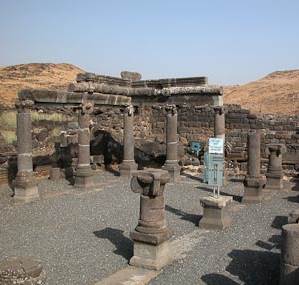
    Luke 13:10-17 is another Sabbath miracle. Jesus is “in one of the synagogues.” I wish I knew which one! But if it’s Capernaum, or Magdala, or Chorazim, we might envision it as a smallish room paved in grey basalt (like the synagogue from Chorazin, pictured here), worshippers thronging together. The woman is sometimes misunderstood as being unwelcome due to gender, or for ritual impurity – but as Amy-Jill Levine and Ben Witherington remind us, this is one more instance of anti-Semitic reading. Women were welcome. The crippled bore no ritual impurity.

   This woman had suffered for 18 years from – osteoporosis? severe curvature of the spine? She has a disability – and the church is finally waking up to issues of disability, which really is a social construct, not a real thing in itself. Can we welcome all people? Can we not even in welcoming disenfranchise or stigmatize the so-called physically disabled?
  I love the marvelous NPR interview with Ben Mattlin - a quadriplegic, who has blogged about the giftedness of disability. He attended a funeral of a friend where all the preaching was about his wheelchair-bound friend being able to jump and run around. Mattlin was mortified, explained why (read his views here), and concluded “Are there no wheelchairs in heaven? I’m not buying it. For me, if there is a heaven, it’s not a place where I’ll be able to walk. It’s a place where it doesn’t matter if you can’t.”

    Jesus’ issue is with the leader of the synagogue. Levine and Witherington suggest that the leader has a fair point: “Medical practitioners today can expect that on Sunday morning they would not be asked between the first hymn and the sermon to provide therapeutic aid to people with nonpainful chronic conditions.” St Augustine allegorizes: “The whole human race is like this woman, bent over and bowed down to the ground” – reminding me of the medieval analogy of the hunchback, forever bent toward the ground, never able to look up and pray, as symbolic of our fallen state. I won’t go there, though. Plenty here without resorting to such.

Monday, December 3, 2018

What can we say August 18? 10th after Pentecost

    Isaiah 5:1-7 is a vivid parable of a well-tended vineyard failing to produce fruit, reminding us perhaps of Jesus finding that tree to be unfruitful. If you visit biblical sites in Israel, you notice the omnipresence of wine presses. Bible people were utterly familiar with vineyards, fruit, wine-making, light years from the elitist sommeliers and wine tours we see today; Bible people were close to the earth, and knew its processes. Gisela Kreglinger, a theologian who grew up in a wine-producing family, has written a fascinating book, The Spirituality of Wine, well worth exploring! A barren vineyard would have raised questions about the roots, the weather, the soil, bugs, laziness.

    Isaiah 5 is couched as a love song, beginning in tender joy (with verbal echoes of the Song of Songs!) – but it turns quickly to scathing critique, featuring wickedly harsh wordplay. God looked for mishpat (justice) but found only mispach (bloodletting); God sought zedekah (righteousness) but found only ze’akah (a yelp of pain). Memorable, haunting words that cannot have been well-received by the smug who first heard them.

     Preparing to preach on this? Drive to a vineyard, get in a conversation with a laborer or two, or the vintner. Ask about frustrations. Get the feel of the place. Get the feel of what God felt. Or ask people around your parish or neighborhood of times they felt they had labored hard but earned nothing but exasperation in return. You’ll be getting close then to the heart of this text.

     Hebrews 11:29-12:2 continues the roll call of Israel’s heroes of faith from last week. I love the “time will fail me” in v. 32 – kin to the scene in Sleepless in Seattle, when Jonah springs a phone call with radio therapist Dr. Marcia Fieldstone on his dad, Sam. She asks, “What was so special about your wife?” He responds, “Well, how long is your program?” The preacher can tantalize people by playing on this, and just rattling off names and brief summaries of the exploits of Bible heroes (including those saints who've lived past Bible times!).

     How intriguing is Hebrews’s spin that “They grew powerful out of weakness” – a common biblical theme, and one re-popularized in our day by Jean Vanier, Brené Brown and others. Verse 38 reminds us of the Desert Fathers… Even all these great heroes didn’t get what God has prepared, which is better. Wow. If so, for us, we “put aside every impediment” – raising homiletical questions about what impediments people carry around like some heavy backpack.

    The race running image: if you aren’t a runner, or even if you are, interview a few runners. Review the text and see what they say about running, discipline, the mental battle, injuries, cheerleading, whatever.

    And the “cloud of witnesses” image is so powerful! I preached a few years back at our conference’s memorial service for clergy and their spouses who had died in the past year. I tried to think about tears – which are little droplets of water. What is a cloud, but little droplets of water all together? And that such little droplets are at their most colorful and beautiful – when? – at the end of the day, as the sun is setting. We have lost great ones, and we have tears – but those tears are gathered up into a cloud, and the refraction of light is stunning, lovely.

    Finally, Luke 12:49-56 is a great text, although I won’t focus on it. The family division is tough to talk about, although we have someone like St. Francis of Assisi (who could be an addendum to the Hebrews 11 list!) winding up cut off from his father Pietro because of his following Christ (as depicted so powerfully in Giotto's fresco). Certainly Christian faith doesn’t make families chipper or hold them together. It might, but often does not. Idolatry of the family is one of the naggingly pernicious blockers to people following Jesus – again, growing out of our nasty tendency to think that the Christian life is about being nice, or my goodness, or as a prop to our prearranged, preferred lives. Serious adherence to Jesus inevitably breaks down human relationships.

Sunday, December 2, 2018

What can we say August 11? 9th after Pentecost

    Isaiah 1:1, 10-20 is sort of an overture to Isaiah’s message, a little introductory anthology of his primary themes. Reluctant as we and our people might be to hear it, Isaiah’s mission is the disclosure of Israel’s sin (and our sin), the certainty of judgment, and their dire need of repentance. How interesting: the lectionary skates past verses 2-9, which expose the extent of Israel’s sin (which isn’t a minor peccadillo now and then but thoroughgoing fallenness!) and the severity of God’s judgment.

    The preacher needn’t skip – although any such preaching is dicey, as a call to repentance can be a thinly veiled expression of my frustration and anger at my people, or else a weirdly popular kind of grandstanding where our summons to repentance is nothing but a thinly-veiled critique of what we don’t like out there. To what degree is current talk about repentance something we think somebody else out there out to be doing? Examples abound… Or if we internalize it, how much is writhing in a mood of guilt, instead of genuine Old Testament repentance? – which would pick up on the Hebrew shuv, meaning to make a 180° turn, or even the Greek metanoia, meaning a change of mind? It’s not feelings of remorse, but real change.

   How, in the wake of shootings and so much public agony, do we call not only ourselves, and not only the church, but even the nation to repentance - in a meaningful, hopeful way? Exposing the false gods (which Marianne Williamson named during the last Democratic candidates' debate) is a starter, and keeping it focused on what God is doing or might do soon: both matter immensely. People, especially the younger ones, are known to crave relevant preaching, and some courage from us. How can I exhibit deep love while being courageous? So: Let's take up why worship, and even prayers, might bore or infuriate God - and then Isaiah's indictment of "blood on the hands."
    Isaiah (whose name means “The Lord saves”) sees a vision. Fascinating: like the author of Revelation, he is vouchsafed a glimpse into heavenly realities, into God’s very presence. Down on earth, the year must be 701 B.C.E.  After the stranglehold of the Assyrian juggernaut, Zion alone is left, and barely. The people foolishly saw its survival as a great blessing, as if God were pleased with them and not others. Always beware any theology that says I made it, they didn’t, God has sure been good to me.
    Isaiah gives voice to God’s exasperated assessment of their worship. At our previous denominational General Conference, I penned a blog on this that went viral – as it wasn’t hard to imagine, after our lovely, moving worship, overhearing God saying “Remove from me the noise of your worship,” as we fought like cats and dogs once worship had ended. Isaiah’s God chides them for the futility of their sacrifices – making me shudder, as we don’t even bother with the sacrifices before we cause God to shudder.
   Notice that God notices that their “hands are full of blood” (v. 15) – thinking of their guilt, reminding us of Lady Macbeth. In Israel, worshippers hands were not just metaphorically stained with blood. The animal sacrifices would have left bloody traces on their hands, a vivid image the prophet points to. The preacher can play with this: Pilate tried to wash his hands of Jesus but could not. Lady Macbeth could not rid her house of its guilt. Jesus, the bearer of all guilt, died with his own blood all over his own hands. I wonder if this is a Sunday to revive a couple of those old, gory but theological pointed hymns about the blood of Jesus.

   With the numbing horror of repeated mass shootings, the "hands full of blood" image makes you shiver. We need to speak in wise ways on this. I tried to in last Sunday's sermon - echoing some of what I blogged about a while back about the futility of "Our thoughts and prayers go out to the families of the victims."

   Hebrews 11:1-3, 8-16 begins a long, eloquent text, a roll call of heroes of the faith, as if the author was thumbing through Scripture in his mind. I wonder if the preacher might do just that: hold a Bible, start in Genesis, thumb through, mentioning Abel, Abraham, Moses, David. I’d add a few from the New Testament, and church history (“By faith, St. Francis…” “By faith, my grandmother…”).

    People think faith is believing spiritual things, or having religious feelings, or trusting God will do stuff I ask for. Hebrews, with simplicity and yet near-philosophical sophistication, defines faith as the substance (hypostasis, what stands under or supports, a foundation, and thus the real nature of things, with the added nuance of serving then as a pledge, a down payment) of things hoped for (elpizomenon). Hope is always worth repackaging for our people. Late in his life, Martin Luther King, Jr., said “I am no longer optimistic, but I remain hopeful.” Christopher Lasch distinguished these well: optimism believes things will get better tomorrow; hope is ready if things don’t get better. Optimism is up to us doing better; hope depends on God.
    Faith is “the conviction of things not seen.” What isn’t seen? Invisible, spiritual realities? Not in the Bible’s understanding. The unseen things are in the future. Our future is secure with God, so faith can live in the uncertainty and even agony of now. Luke Timothy Johnson: “Faith makes actual, or makes ‘real,’ for believers the things that are hoped for, as though they were present… They are understood to be as real, or even more real, than things that can be ‘seen,’ that is, verified by the senses.” Here I love a thought David Steinmetz used to emphasize about Martin Luther – for whom “the organ of faith” was the ear, not the eye. The eye can deceive; we are fooled by what we see (or don’t see). The ear hears – and hears God’s Word, which can be trusted no matter how things look.
   Hebrews deftly reminds us that when Abraham was called, “he went, not knowing where he was to go.” Genesis 12 portrays God telling Abraham to go – where? “A place I will show you.” Jesus called his disciples to go… where? They had no clue. In my Will of God book, I explore this at some length: we want a map, or to know “God’s plan for my life,” when in reality we simply follow, taking the next step. “Thy word is a lamp to my feet” – not a brilliant Coleman lantern, but a Bible-times little pottery lamp that might light up the road for about 4 or 5 feet. You go, you take the next step, then the next. Faith is going, moving - as Father Greg Boyle (who spoke here on Monday!) reminds us, "Faith isn't about saluting a set of beliefs. It's about walking with Jesus and being a companion, particularly standing in the lowly place with the easily despised and readily left out." Is his model of how to be in ministry with gang members a window into how to transform our violent society?
    Hebrews 11’s images are powerful. Abraham “had no city,” but God was creating one for him (and God’s people). Robert Caro tells about Lyndon Johnson arriving in Washington as a young man from the hill country of Texas. He would walk toward the Capitol building, glistening in the rising sunshine, and he would begin to run out of sheer delight. Sarah had no fertile womb. God’s will, God’s way for you, but more importantly for God’s church, does not depend on our resources but on God’s vision and our following, not our ability but our availability.
    How poignant is it that Abraham (just like Moses) died not seeing the fulfillment of the promise, not participating in what all of life had been a pursuit of. No, he “greeted it from afar.” Moses did this from Mt. Nebo: Hello, promised land… The preacher would be wise to point to Martin Luther King, Jr.’s final sermon (“I’ve seen the promised land… I may not get there with you”) – or Reinhold Niebuhr’s great wisdom (“Nothing worth doing can be accomplished in a single lifetime; therefore we are saved by hope”).

     Luke 12:32-40 is an assortment of Jesus’ short, pithy sayings. We might think of Wendell Berry’s similar list of counsels, “Manifesto” (“Every day do something that won’t compute. Work for nothing. Denounce the government and embrace the flag. Give your approval to what you cannot understand. Praise ignorance. Ask questions that have no answers. Plant sequoias. Practice resurrection”). How different (worth noting in a sermon!) are Jesus and Berry from the conventional wisdom you find on posters or in chat rooms.

    A few details. Jesus calls them his “little flock.” How tender. How humbling for them, and yet how hopeful. “Let your loins be girded” means, as Levine and Witherington put it, “Let your long, ankle-length robe be adjusted by the waist-belt to ensure readiness for action or departure.” The “breaking into” of the thief means literally “dug through.” We can paint the picture of the mud-brick walls of houses in those days. It would take a while – almost like Andy’s escape from prison in The Shawshank Redemption!

    As always, Jesus emphasizes our need to travel light, to own little, to give with abandon – and that to lay up treasure in heaven is accomplished not by being pious but by outlandish, generous giving to those in need (as Augustine, Ambrose and Chrysostom explained early on). If our people wonder why we don’t experience much Jesus or resurrection, we need look no further. How might we, and our people, make even incremental progress on such things?

Saturday, December 1, 2018

What can we say August 4? 8th after Pentecost


     I’m unsure which text I’ll choose, or if I’ll try a pair. All three are suggestive. Hosea 11:1-11 was a text I weirdly fell in love with in college. Taking a great course from Prof. Carl Evans on the prophets, I was coming to understand the severity of the judgment articulated by Amos and Hosea in the 8th century. This text’s turn from judgment to tender hope was so moving – and then some friends at church were digging this Christian band called Lamb, whose song “Comfort Ye My People” picked up on themes from Hosea 11, and then “Ephraim” replayed Hosea’s words explicitly. I was mesmerized by the Hebraic-feeling music, and the content. I wonder how often in preaching your own personal history with a text can be the stuff of a meaningful sermon – as we really are inviting our people to enter into a personal history with a text.

   How revolutionary, this image of God as the tenderly loving parent, history recast not as the movements of powers, but as a parent fondly caressing a child. The child isn’t useful, but helpless. Can we visualize God teaching a wee one to walk, scooping her up in the divine arms, lifting an infant to his cheek. Hans Walter Wolff’s great commentary notes how Hosea was the first to use “love” for how God chose and sustained the people: “The first event in the life of young Israel worthy of report is that Yahweh loves him.”

    Mind you, Freud popularized a common critique of religion – that our desire for God as parent is nothing but wish projection. 
Rabbi David Wolpe’s rejoinder? “That we wish God to be a parent does not prove that God must be a purely human projection. We also wish that flowers bloom, that children laugh, that sunsets streak red on the horizon. Perhaps we do wish God to be a parent. Perhaps God obliges. We cannot be asked to discard a belief because it comforts us.”

    I love that. The child in Hosea 11 is recalcitrant – and know as you preach, someone out there has loved a child who has bolted. God’s swirling rage of emotion is riveting. The Ancient Near Eastern deities bickered among themselves over whether to toss down thunderbolts or show mercy. Yahweh carries on that debate within Yahweh’s own heart. The emotion embedded in “How can I give you up? My heart recoils within me…” can be repeated and left to linger in the room while you’re preaching. Let the words do their own work in your rebellious children! Wolff’s remarks are wise: “God is completely sovereign over his own actions. He, unlike men, is independent of his partner’s actions – not compelled to react. The future will be determined by Yahweh’s decision to let his love rule.”

   Hosea likens the Lord’s coming to a lion. I likely will turn to C.S. Lewis’s The Lion, Witch and the Wardrobe’s moment when Mr. Beaver tells Susan Pevensie about Aslan. She trembles, saying “I shall feel rather nervous about meeting a lion. He’s safe, isn’t he?” Mr. Beaver: “Safe? Who said anything about safe? ‘Course he isn’t safe. But he’s good. He’s the king.”

    Colossians 3:1-11. Our post-Easter logic might be “If Christ is raised, you live assured you’ll go to heaven.” But for Paul, if Christ is raised, “then seek the things above.” The resurrection is like a mind/heart transplant. You think differently; you fixate on heavenly/divine things. Your life is “hidden” with Christ in God (kekruptai rightly reminding us of the adjective “cryptic,” as there is something mysterious – to others and even to yourself – about this life in Christ). It’s hidden: your Baptism, your conversion is in the past, yet that hidden past persists in you now; and the future is similarly hidden, your fruitful life in the fullness of God’s kingdom – the fruitfulness which commences now.

   Paul’s imagery intrigues. Not “try to do better” but “Put to death” anger, wrath, malice (notice how what we are to avoid can we characterized as the “seven deadly sins,” which weirdly have come to embody the “good life” in America!). The execution in question would be to visualize nailing these problematical moods to the cross – sort of the inverse of what we cited last week from Austin Farrer: “What, then, was done to this body? It was stripped, scourged, and nailed to a cross: stripped of all dignity and all possession, scourged with the stroke of penal justice, and nailed up like a dead thing while it was still alive. The body you receive in this sacrament accomplished its purpose by nailing to a tree. You are to become this body, you are to be nailed: nailed to Christ's sacrificial will. The nails that hold you are God's commandments, your rules of life, prayers, confessions, communions regularly observed. Let us honour the nails for Christ's sake, and pray that by the virtue of his passion they may hold fast.”

   Paul shifts rapidly from the nailing image to clothing. The stripping off and the putting on: used often in Colossians. We might think of later baptismal rituals and the symbolism of new clothing. I love that moment when Francis of Assisi, removed his chic, stylish clothing, returned it all to his father Pietro, and donned the shabby attire of the poorest of the poor. I suspect we could persuade the most diligent of our people to try every day for the next week to stop when dressing in the morning, praying in their closet (as Jesus suggested in Matthew 6!), and envisioning a putting on of Christ for the day.

   For us, we are in a summer series on the meaning of various acts of worship. The offering will occupy us this day – as the offering isn’t raising money for the budget, but a demystifying of wealth, the weekly, worshipful counter to greed and the outsized place money plays in society and in our hearts. Colossians 3, and the Gospel text both stand as deadly serious warnings against laying up treasure on earth – and thus paradoxical invitations to generosity.

    Luke 12:13-21 is one of those texts that is so easy to ruin in the explanation. Like a good joke, talking about it shreds its impact. I wonder about the sermon that has a bit of an intro, and then just lets the parable linger in the air for people to ponder. Where I live, very fine homes are purchased, and torn down, to build bigger houses. But Jesus isn’t blasting people for their tear-downs… or is he? There’s a larger issue, of course, with these bigger barns.

    The context is pivotal. Someone in the crowd says “Teacher, tell my brother to divide the family inheritance with me.” My mother died in February – and in handling her various accounts, I felt weird, unanticipated emotions rising up regarding who got what, how much, and why. I’d bet plenty of people I’ll preach to have felt some weirdness around inheritances. Jesus’ warning is to be on guard against “all kinds of greed.” That’s worth exploring: maybe greed isn’t just a thing, but a complex thing. There are “all kinds of greed.” Differing greeds about money. Greed for me can be about time. What is it for you? What do you suspect are the “all kinds of greed” your people harbor in their souls? Maybe you ask in the sermon, and leave some time for them to reflect without over-naming it for them.

    Jesus humorously portrays the guy in his parable as talking to himself. Amy-Jill Levine and Ben Witherington point out that “Interior monologue in the Gospels is not a sign of wise circumspection but of self-centered plotting.” A better translation might be “calculated.” This parable is, of course, a variation on Jesus’ theme that rarely elicits much attention from “The Bible is clear!” people. “Do not lay up treasure on earth,” which we are masters of doing, and explaining away. Interestingly, and in fine Wesleyan fashion, Saints Ambrose, Augustine and Basil all construed the building up of ever greater barns for my own possessions as theft from the poor. The preaching challenge is how to convey any of this without browbeating? How do we not let them wriggle out from the stark claim of Jesus’ wisdom without castigating them? We begin with finding the words to speak with oneself as the preacher, who owns a few barns of his own?